
If you let property in the UK, your 2025–26 tax return has to be filed online by 31 January 2027. It's also the day you pay any tax you still owe for that year, plus your first payment on account for 2026–27 if you make them.
This year's return matters more than usual. If your rental and self-employed income together came to more than £30,000 in 2025–26, it also decides whether you have to join Making Tax Digital from April 2027. And from 6 April 2027, rental profits are taxed at new, higher rates.
Here's what to include, what you can claim, and how to make next year easier.
Key dates
| Date | What happens |
|---|---|
| 31 January 2027 | Online return for 2025–26 due. Pay any balance for 2025–26 and your first payment on account for 2026–27 |
| 31 July 2027 | Second payment on account for 2026–27 |
| 6 April 2027 | New property income tax rates start. Making Tax Digital starts for landlords with qualifying income over £30,000 |
Miss the 31 January deadline and there's an automatic £100 penalty, even if you owe no tax. More penalties follow after three months, and interest runs on any tax paid late.
What counts as rental income
Include everything you received from letting for the tax year 6 April 2025 to 5 April 2026, including:
- rent, including any received in advance
- any part of a deposit you kept, for example to cover damage or unpaid rent
- payments from tenants for services you provide, such as cleaning or utilities you pay for
Most landlords use the cash basis, so you count rent when it actually reaches you, not when it was due.
Expenses you can claim
You can deduct costs that are wholly and exclusively for the letting business. The common ones are:
- Letting and management fees and advertising for tenants
- Repairs and maintenance, such as fixing a boiler, repainting or replacing a broken window. Improvements, like an extension or a new conservatory, aren't allowed here
- Replacing furnishings like-for-like, such as a sofa, carpets or a fridge (replacement of domestic items relief). The first purchase for a property doesn't count
- Insurance, including landlord buildings, contents and rent guarantee cover
- Ground rent, service charges and any council tax or utilities you pay
- Safety certificates and compliance, such as gas safety checks, EICRs and EPCs
- Accountancy fees, and legal fees for lets of under a year
- Travel to and from your properties for the letting business
- Software you use to run the lets, such as property management software
If your gross rental income is low, you can instead claim the £1,000 property allowance and not deduct any actual expenses. You can't do both.
Mortgage interest: the Section 24 rules
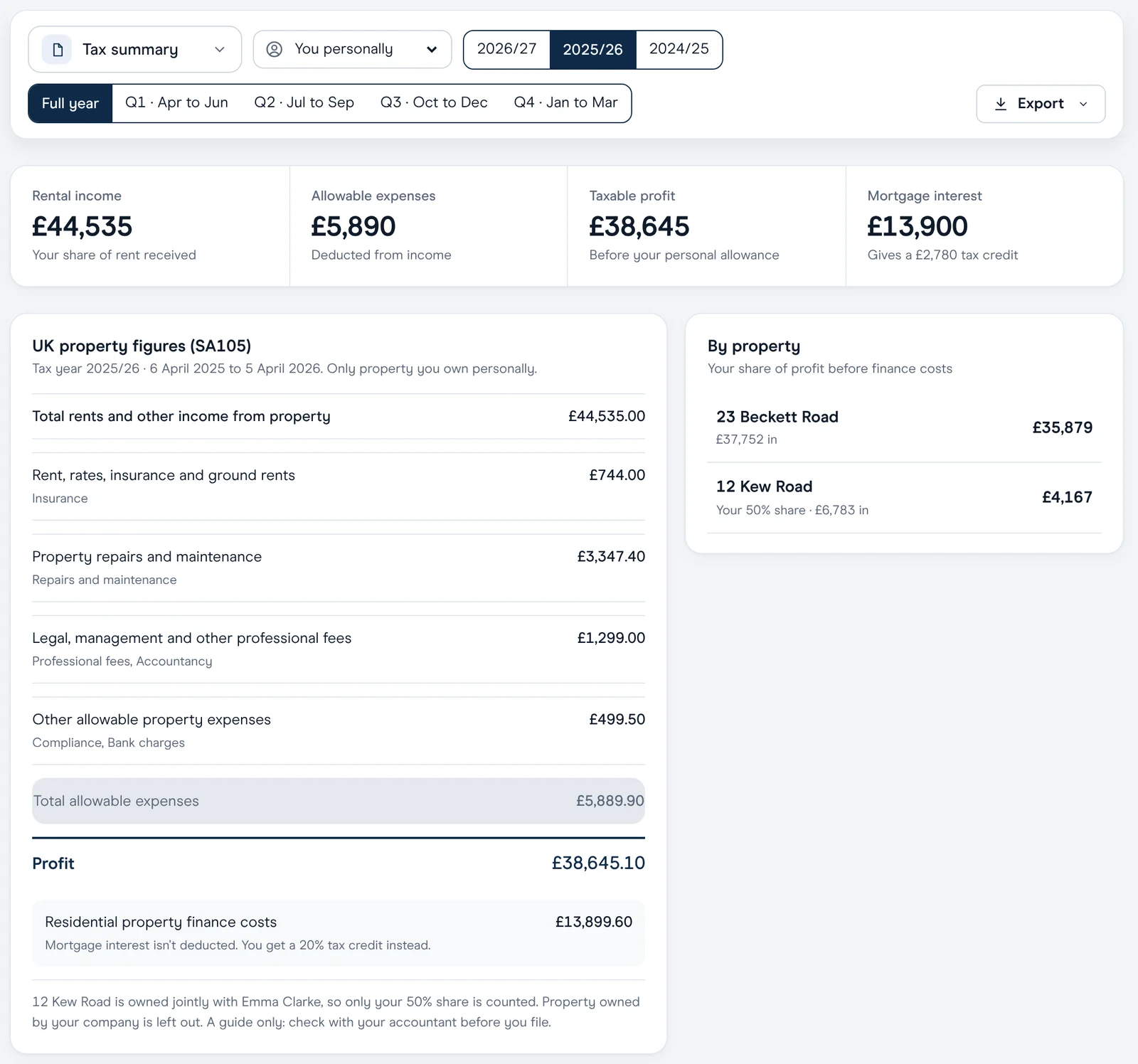
You can't deduct mortgage interest from your rental income if you own property in your own name. Instead, you get a tax credit worth 20% of your finance costs, which is taken off your tax bill.
For basic rate taxpayers, this often works out much the same. For higher rate taxpayers, it means paying tax on rent that's really going to the bank. It's one of the reasons many landlords look at whether a limited company suits them. That's a decision to make with an accountant, because of the tax costs of moving properties across.
Jointly owned properties
If you own a property with someone else, each of you declares your own share of the income and expenses. Married couples and civil partners are usually taxed 50:50, unless you own it in unequal shares and have told HMRC using Form 17.
What changes next
Making Tax Digital. If your qualifying income from property and self-employment was over £30,000 in 2025–26, you'll need to keep digital records and send quarterly updates to HMRC from 6 April 2027. The threshold drops to £20,000 from April 2028. The government has said landlords joining in April 2027 won't get penalty points for late quarterly updates during 2027–28, but the updates still have to be sent.
Higher tax on rental profits. From 6 April 2027, property income is taxed at its own rates in England, Wales and Northern Ireland: 22% at the basic rate, 42% at the higher rate and 47% at the additional rate, two points higher than now.
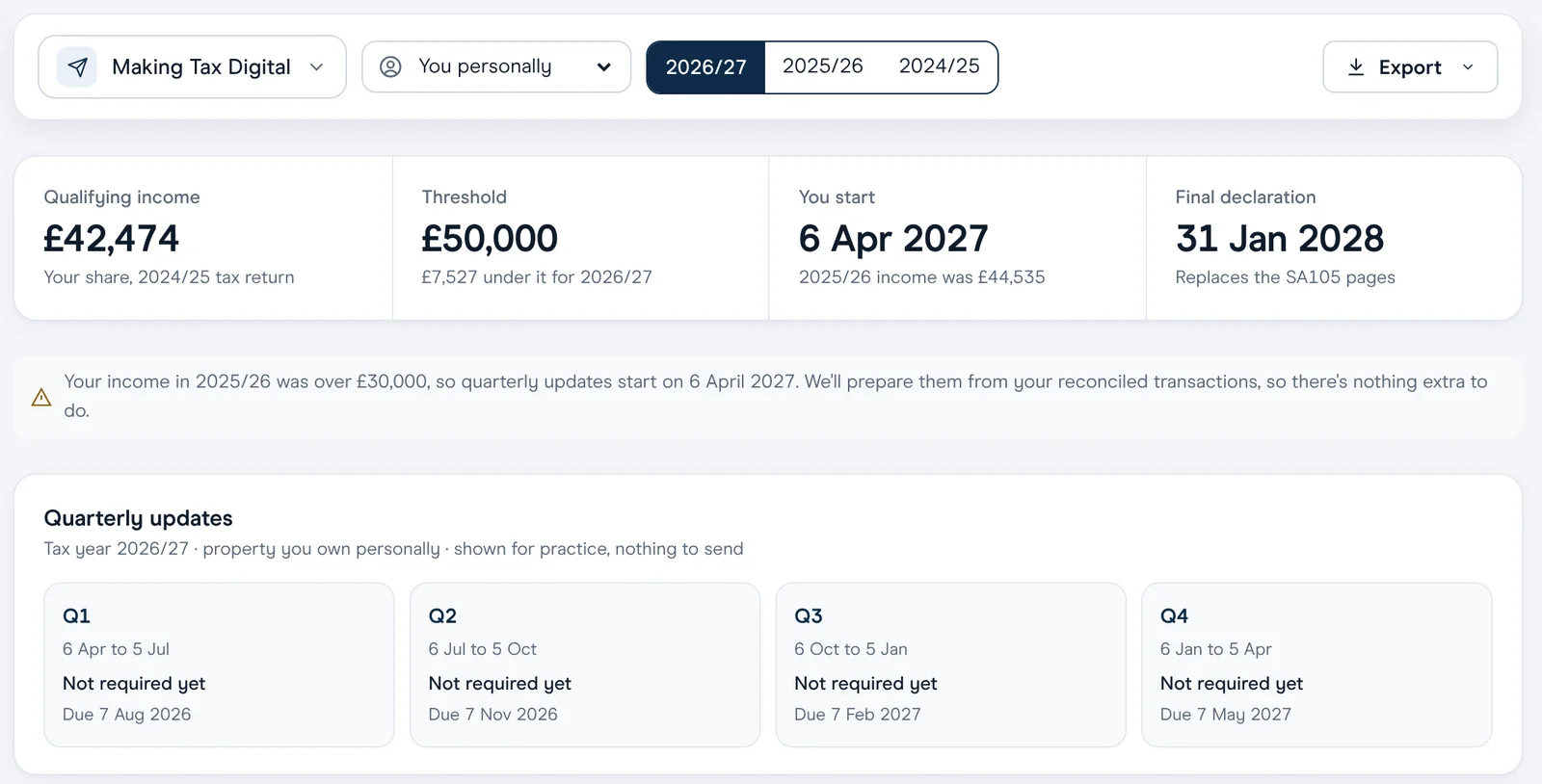
Both are good reasons to get your records into shape this year, not next January.
Keep records the easy way
HMRC expects you to keep records for at least five years after the 31 January deadline for each return. The landlords who find tax season easiest are the ones who don't leave it all until January.
How Alphaletz helps
Alphaletz connects securely to your bank, so your rent and bills come in automatically. Each payment is matched to the right property and tenancy, and costs are sorted into categories as they arrive, ready for your return.
- Income and expenses by property, with a profit and loss report for the year
- Split by portfolio, so properties owned jointly or in different names are easy to separate
- Receipts and certificates stored against each property, so the evidence is there if HMRC asks
- A tax summary laid out like your return, with the figures for the UK property pages (SA105), your share of jointly owned homes and the mortgage interest for your tax credit
- Making Tax Digital, ready when you are. Alphaletz works out whether and when you need to join, and prepares each quarterly update from your matched transactions, ready for your accountant or MTD software
- Reports your accountant can use, without rebuilding a spreadsheet from bank statements
You can try Alphaletz free for 14 days, no credit card needed.
Questions landlords ask
When is the deadline for my 2025–26 tax return?
31 January 2027 for online returns. It's also when you pay any tax still owed for 2025–26 and your first payment on account for 2026–27.
Can landlords deduct mortgage interest?
Not if you own the property in your own name. You get a tax credit worth 20% of your finance costs instead, which is taken off your tax bill.
Do I need to join Making Tax Digital in April 2027?
Yes, if your qualifying income from property and self-employment was over £30,000 in 2025–26. The threshold drops to £20,000 from April 2028.
What are the new property income tax rates?
From 6 April 2027, property income in England, Wales and Northern Ireland is taxed at 22% (basic), 42% (higher) and 47% (additional), two points higher than now.
Sources
- GOV.UK: Income Tax: changes to tax rates for property, savings and dividend income
- GOV.UK: Reduction of the mandation threshold from £30,000 to £20,000 from April 2028
- AccountingWEB: Budget 2026's MTD penalty easement
This guide is general information for landlords in England, Wales and Northern Ireland for the 2025–26 tax year. It isn't tax advice. Your situation may be different, so speak to an accountant or tax adviser before making decisions.
Next steps
Try Alphaletz free for 14 days, no credit card needed, or if you manage 10 or more properties, book a personalised demo.